Ants, a world of more than 20,000 species
- Nomadic ants: They have no fixed nest and are constantly on the move.
- “Farming” ants: They herd aphids to harvest honeydew, defending them from other predators.
- Fungus-growing ants: They cultivate their own fungi underground as a food source.
Why do some disappear quickly while others seem utterly unstoppable?
- The straightforward case: Sometimes the problem is a small satellite nest located in a plant pot, a flower bed, or a gap in the wall. Here, a targeted professional treatment delivers a quick and permanent solution.
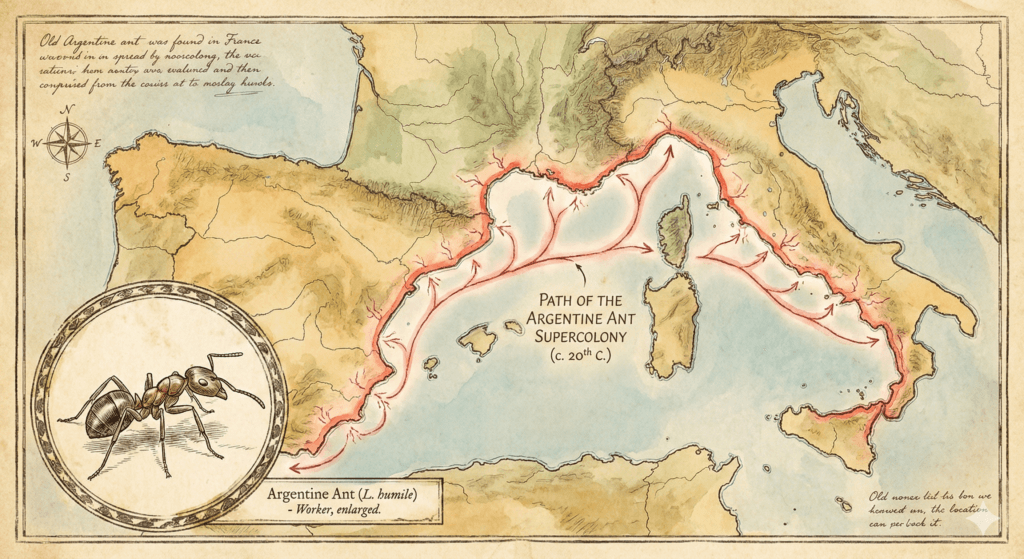
- The supercolony challenge: This is where the science becomes truly remarkable. Certain species, such as the Argentine ant (very prevalent in our area), do not form simple nests — they form supercolonies.
When the enemy spans kilometres, the strategy has to change
If the ant colony affecting your home or business forms part of a network extending across hectares or square kilometres, treating just a few metres of your living room is like trying to empty the sea with a bucket. In these cases, eliminating the problem 100% permanently is, technically speaking, impossible. This historical map illustrates how the Argentine ant forms massive supercolonies stretching thousands of kilometres along the Spanish coastline. Due to this complex social structure, home remedies tend to fail. Effective control of this pest requires professional intervention. If you detect this type of invasion, contact the experts at RapiPlaga.
So what should we do?
- Strict hygiene: It is essential to remove anything that might attract them. Not a crumb, not a drop of juice, not exposed pet food. If there’s no reward, they’ll look elsewhere.
- Control access points: Sealing cracks and entry points helps, although ants are masters at finding alternatives.
- Professional maintenance: When pest pressure is high due to environmental conditions, the solution is not a one-off treatment but a periodic maintenance plan. The goal is no longer to eradicate the species entirely (impossible with supercolonies), but to create a barrier and keep them “at bay” so that your home remains a clean and peaceful space.