If there is one thing the RapiPlaga team can promise you, it is that panic is the worst enemy of an accurate diagnosis.
Until recently, our biggest challenge when identifying an infestation was not the insects themselves, but hasty diagnoses.
You can’t imagine how many times we have arrived at a home where the customer insisted they had spiders because “the pharmacist said so” after seeing the welt, and after our technical inspection it turned out to be bed bugs.
There was, and still is, a logical mismatch: the doctor treats the symptom (the inflammation), but does not visit the home or know how the pest behaves. Even so, the customer often remained somewhat suspicious of the pest control company, even when we showed them the physical evidence.
Today, a new player has joined the scene and is making urban pest management more complicated: artificial intelligence.
The danger of digital self-diagnosis
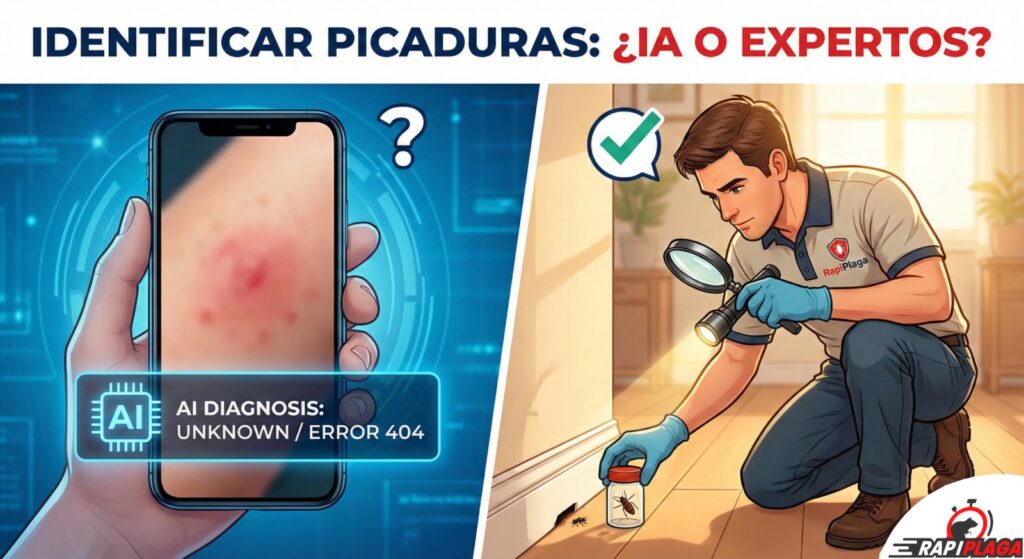
Nowadays, anyone with a mobile phone and an AI app thinks they have an entomologist in their pocket. The customer takes a blurry photo of a mark on the wall or a reaction on their skin, and the AI gives them a scientific name that becomes an undeniable truth.
The result is usually unjustified panic, buying ineffective household insecticides and emergency calls based on a mistake. For now, AI cannot replace a professional pest diagnosis, and here we explain why.
1. Your phone’s camera is not a microscope
Entomology is a complex science. To tell certain species apart and apply the right treatment, we sometimes need to look at tiny details such as the hairs on the legs, the structure of the wings or details of the antennae.
Most phones do not have good enough macro lenses. A badly lit photo with no sense of scale cannot be analysed properly by an algorithm. Often, what the app identifies as a dangerous pest is simply a harmless garden beetle that came in through the window. Relying on that result can lead you to spend money on treatments you don’t need.
2. Every person’s skin reacts differently to bites
This is the most critical point and where we see the most mistakes: trying to identify the insect from a photo of a bite alone is a mistake.
How your skin reacts to a bite depends less on the insect and more on your immune system.
A flea bite or a bed bug bite can cause a severe allergic reaction in one person.
The same insect biting another member of the same family may leave no visible trace at all.
AI does not know your allergy history or how sensitive your skin is. It only sees a red swelling and searches its database for similar images. This leads to thousands of false diagnoses that increase anxiety and delay the real solution to the problem.
The empirical truth: why trust pest control professionals like RapiPlaga rather than an app?
This is where the irreplaceable value of a qualified technician comes in. Unlike an app, a dermatologist or a pharmacist, we are the only ones who complete the chain of evidence through an on-site inspection:
We analyse the surroundings: we check beds, skirting boards, cracks and warm areas.
We find the culprit: we locate the nest or the insect that caused the damage.
We apply the solution: we design a tailored plan.
We are the group with the highest success rate in matching “bite and insect” for a simple reason: we work in the field. Our technicians have years of experience going from home to home, linking the skin lesion to the pest they find. That experience is our database, far more reliable than any internet algorithm.
Conclusion
Technology is a fantastic tool, and we have no doubt that AI is revolutionary and here to stay. But when it comes to the environmental health of your home, a trained eye and a physical inspection are still irreplaceable, at least for now.
If you have recurring bites or suspect insect activity, don’t ask an AI. Save time and protect your family’s health by contacting the people who really know where to look.
At RapiPlaga we don’t guess. We diagnose and solve.
Think you have a pest problem? Request your technical inspection with RapiPlaga today.