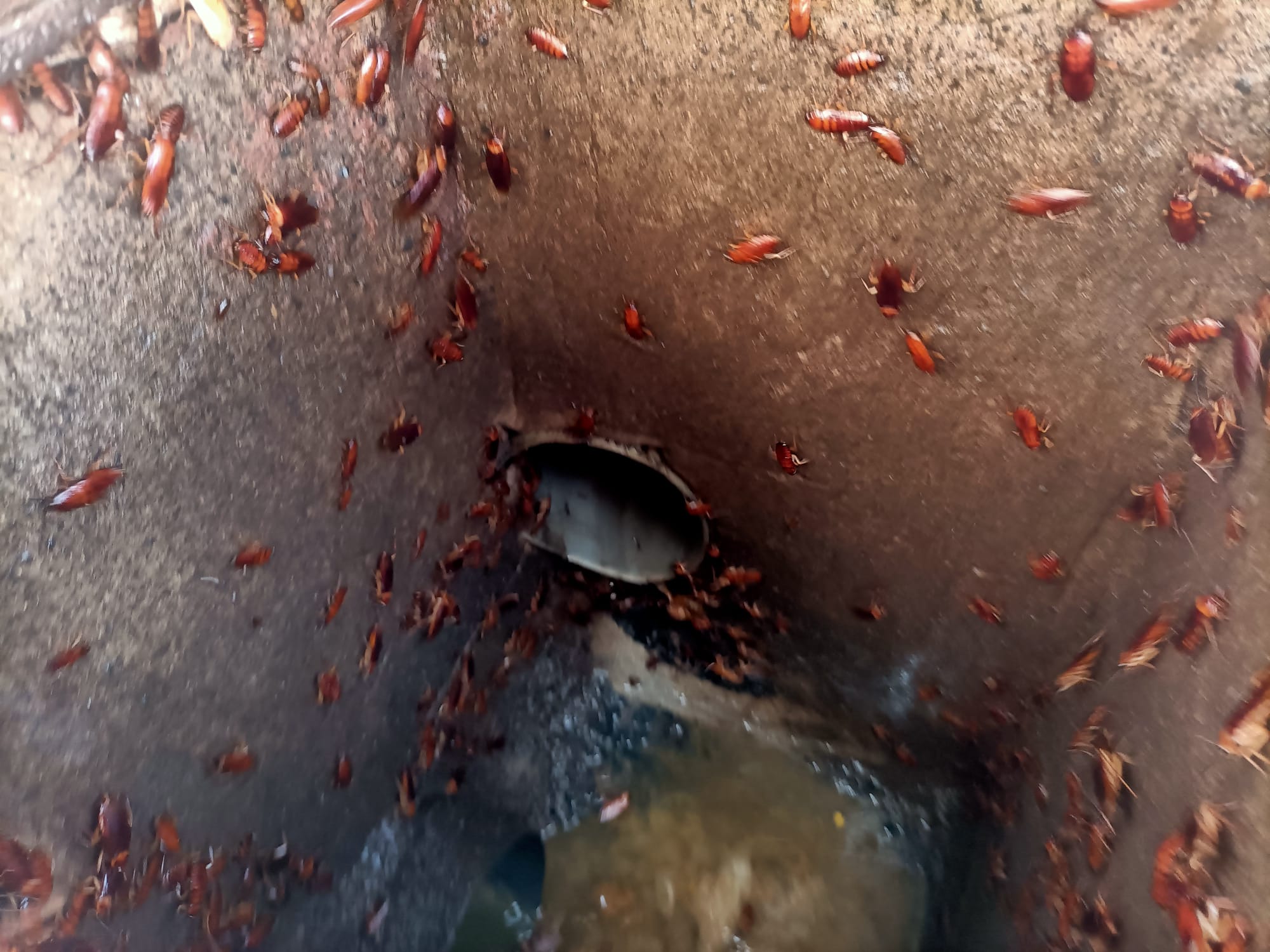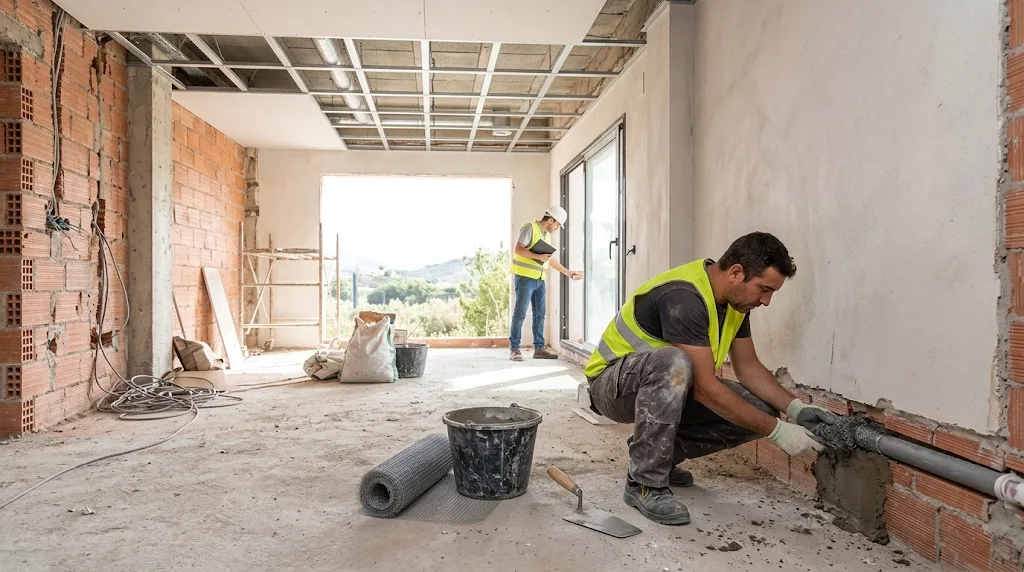
If you are refitting a kitchen, building a house in Mijas or replacing the drainage of a commercial unit in Marbella, you have an opportunity in front of you that will not come round again. With the suspended ceilings open, the chases exposed and the drainage dismantled, shutting a pest out costs a few euros and ten minutes of a bricklayer’s time. Two years later, with everything tiled and furnished, closing that same gap means breaking out tiles, making a mess, spending a fortune or living with a permanent pest problem.
And yet it is precisely what almost nobody checks on site.
At Rapiplaga we see it daily: newly handed-over flats, spotless, with American cockroaches climbing up through the shower tray in their first summer. Birds nesting inside the chimney before the owner has even moved in, filling the house with mites. Restaurants that open with a perfect design and a two-centimetre gap under the service door that lets rats and cockroaches straight in.
The problem is hardly ever hygiene. It is the gap nobody closed.
What physical exclusion is, and why it comes before any product
In our trade it has a name: physical exclusion. It sounds technical, but the idea is simple: if it cannot get in, you do not have to kill it indoors.
It is the first step of any integrated pest management plan and also the most cost-effective one for you. A door seal lasts ten years. A treatment has to be repeated.
To give you an idea of how little each pest needs to get into your home or your business, here are the real openings:
| Who gets in | Gap it needs | Usual route |
|---|---|---|
| Rats | 20 mm | Drainage, chambers, under doors, underfloor void openings |
| House mouse | 6 mm | Service penetrations, movement joints |
| American cockroach | 5 mm | Gullies, chambers, soil stacks |
| German cockroach | 1.5 mm | Packaging, skirting, appliances |
| Tiger mosquito | Mesh coarser than 1.2 mm | Windows, service shafts, vents |
| Sandfly (leishmaniasis vector) | Mesh coarser than 0.4 mm | Standard insect screens, basements |
Note the detail that surprises everyone: an ordinary insect screen does not stop a sandfly. And on the Costa del Sol, with the dog sleeping out on the porch, that matters.
Now let us go gap by gap.
Not to mention the ventilation holes left in many facades using the hollow cores of the bricks: wasps treat them as an irresistible invitation.
1. Drainage: this is where the match is won or lost
If you can only keep an eye on one thing during the whole job, make it this one. The vast majority of American cockroaches and rats we take out of a home did not come through the door: they came up the pipe.
The sewer network is a motorway with food, moisture and a steady temperature all year round. The only thing separating that motorway from your living room is a few centimetres of water in the right place.
Trapped inspection chambers where they belong
Spanish building regulations (CTE DB-HS 5) already require a trapped chamber where the buried rainwater and foul drains meet. That water seal is, quite literally, the plug that stops whatever lives in the municipal sewer from coming up onto your plot.
Three things go wrong on site, in order of frequency:
- It is designed and never built. The drawing shows it; what turns up on site is a plain or a junction chamber. Check it during a site visit, not on the drawing.
- It is built and then dries out. A water seal that is never used evaporates in summer and leaves the route wide open. In holiday homes on the coast, that is the classic September call.
- It is left without a sealed cover. Cast iron cover, frame and gasket, and it must actually close. A cover that rocks is a cat flap.
- The pipe sleeving is badly fitted. It leaves a gap running from the chamber to every water outlet in the home.
Watch out for one detail that gets confused a lot: the chamber at the foot of a soil stack must not be trapped, it is an access point. The trapped one goes where the drains meet, before the connection to the sewer.
Water seals and gullies
The regulation sets the water seal depth between 50 mm for continuous use and 100 mm maximum, rising to 70 mm for intermittent use. In site terms:
- No untrapped gullies in garages, courtyards, bin stores or terraces. That is the American cockroach’s favourite entrance.
- In basements and commercial units, an accessible, serviceable non-return valve: it prevents backflow and, along the way, visitors coming up against the current.
- Outlets that are rarely used (the store-room gully, the utility-room shower) need a membrane trap. In holiday lets we recommend it every time.
- Sanitary fittings too. It still amazes us to see new build with sinks and basins fitted without a trap.
- Bad installations. Since invisible shower drains became fashionable we have seen a sharp rise in cockroaches coming out of exactly that point: the trap is badly fitted and leaves them a clear run.
Gratings and access covers
Screwed-down stainless steel gratings with a clear opening of 5 mm or less, and access covers that genuinely close. The plastic grating you can lift with your foot is decoration.
2. Doors and windows: six millimetres change everything
Kneel down in front of your front door and look at the light coming under it. If you can see the street, a mouse can see a very tempting shelter.
Seals and brush strips
- Target: under 6 mm of clearance between door leaf and floor, across the full width. Not just in the middle, which is where everyone measures.
- On entrances, communal areas, meter cupboards and catering service doors, use a brush strip with a metal core or a reinforced seal. Soft rubber is a starter for a rodent.
- If the door is timber and faces outside, add a metal kick plate to the bottom edge. Thirty centimetres is enough: rats gnaw the edge, not the middle.
- Do not forget the garage door. It is the number one entry point in villas on the Costa del Sol and almost always has three centimetres of clearance at the corners. A hard rubber seal cut to size, or one day the car will not start because a rat has eaten the wiring. (Incidentally, the wiring on VAG group cars must contain something they love.)
Insect screens
The usual mistake here is assuming they are all the same.
- Standard screen (1.2 mm mesh): fine for flies and the common mosquito. Sandflies go straight through.
- Sandfly screen (0.4 mm mesh or finer): what we recommend for homes with a dog, ground floors and plots with a garden or a dry stone wall.
- Use a fixed frame or a roller screen with guides, never hook-and-loop tape. And fit screens to the bathroom vent and the service shaft too, which is how the tiger mosquito gets in when every window is shut.
One renovation tip: if you are replacing the windows, ask for sub-frames ready for screens from the outset. Adding them later always looks worse and costs more.
And for extra comfort, ask for anti-pollen mesh: it needs a little more cleaning, but it is worth it.
3. Roof, chimneys and vents: the top floor has a door too
We get a lot of calls about noises in the ceiling. It is nearly always a chimney without a cowl, an open eaves gap or a broken vent.
Wire mesh on chimneys and flues
- Mesh or cowl in stainless steel. Cheap galvanised steel is eaten by coastal salt in two winters.
- 10 to 13 mm openings to keep out pigeons, gulls, bats and rodents; 6 mm if oriental or Asian hornets are a problem locally, since they look for exactly that kind of sheltered cavity to nest in.
- Screwed or riveted, never tied on with wire. And serviceable, because it needs cleaning: a mesh blocked with soot is a safety problem.
- The same goes for the cooker hood outlet and the tumble dryer vent: a grille with a backdraught shutter plus mesh.
Vents, roof ventilators and cavity openings
These are openings required by regulation that almost nobody protects:
- Basement, store-room and boiler-room vents: stainless mesh on the inside face, 5 mm openings or less.
- Roof ventilators and under-tile ventilation: continuous mesh at the eaves. This is the favourite way in for sparrows, starlings and, in coastal towns, the yellow-legged gull.
- Underfloor void ventilation: protect it, never block it. Closing it off completely trades a rodent problem for a damp and termite one.
Golden rule: sealing an opening without checking what lives behind it is the worst possible decision. Shut a wasp colony or a bird nest in and the problem moves further into the building. Inspect and clear first — call us if you need us — and close afterwards.
4. Service penetrations: the hole the plumber makes and nobody closes
Every pipe, cable and duct crossing a wall leaves a hole. An average home has between 40 and 60 service penetrations. None of them appears in the specification, and that is how half the building’s pest problem moves around.
How to seal them properly:
- Stainless steel wool or compressed metal mesh packing the hole, with mortar or flexible sealant over the top.
- Expanding foam on its own does not work. A mouse goes through it overnight and is perfectly happy nesting in it. Use it to insulate, never as a barrier.
- Seal both faces of the wall. Half sealed is not sealed.
- Crushed glass in the mortar. A crude solution, but done properly it works: the fragments are mixed into the filling mortar. Use gloves and eye protection, or leave it to the bricklayer.
And three points that are always forgotten in a refit:
- Behind the kitchen units: the waste and gas penetrations. That is the classic route for the German cockroach to move from one flat to the next.
- Service shafts and vertical risers: if they run open from ground floor to roof, you have a communal staircase. Compartmenting them floor by floor solves a lot of problems in blocks of flats.
- Suspended ceilings and movement joints: leave access hatches, but make them close. A continuous ceiling void with no access is the best possible refuge for rodents and the worst place to have to treat them.
Timber and termites
If the works touch the structure, the underfloor void or the garden, remember this: do not leave formwork timber buried or site offcuts in contact with the ground, and keep beams, garage doors and timber post bases off bare soil. The subterranean termite needs nothing more. In new build, the time to consider a physical termite barrier is while the foundations are open, not when the wings turn up in the living room.
5. While the works are under way: your home is wide open
Here is something almost nobody allows for: building work does not just leave gaps, it also moves pests around. When a partition comes down, a unit is stripped out or a floor is lifted, whatever lived there does not disappear: it spreads through the building and into the neighbours. That is why on demolition and strip-out jobs we recommend treating for rodents before starting, not after the complaints.
During the works, four habits make the difference:
- Waste and rubble out every day. Keep the skip covered and away from the facade.
- No workers’ food inside the site. One lunch a day for six months is an ant and rodent problem in the making. One place to eat, bags closed.
- No standing water. Buckets, barrows, trays, open chambers, half-filled pools. In Malaga, seven days of still water is one generation of tiger mosquito.
- Keep materials off the floor and off the walls. Pallets 15 cm clear of the ground and 50 cm from the walls. As well as preventing nests, it lets you see what is going on behind them.
And one practice we particularly like: temporarily cap open stacks and chambers at the end of each day. An open soil stack overnight is a direct invitation from the main sewer, and on the Costa del Sol those sewers tend to be busy.
Checklist: run through this before signing off the works
Go through it carefully before you reach the closing-up stage: after that, correcting any shortcoming easily and quickly stops being an option.
- Trapped chamber built where the rainwater and foul drains meet, and holding water.
- Chamber covers with frame and gasket that close properly but are not sealed: a sealed cover cannot be opened when you need it.
- Every gully trapped: garage, courtyard, terrace, bin store.
- Serviceable non-return valve in basements and commercial units.
- Metal gratings screwed down, 5 mm openings or less.
- Clearance under external doors below 6 mm, corners included, with the seal fitted on top.
- Brush strip or reinforced seal on the garage and service doors.
- Insect screens on windows and, on main doors, consider a magnetic one: several mosquito species on the coast transmit disease.
- Sandfly mesh on ground floors and plots with a garden.
- Chimneys and flues fitted with a cowl or stainless steel mesh.
- Vents protected with mesh on the inside face.
- Eaves and under-tile ventilation closed to birds.
- Service penetrations sealed with steel wool and mortar, both faces.
- No site timber buried or left in contact with the ground.
- No standing water on the plot on handover day.
Frequently asked questions about pest proofing on site
When is the best moment to check physical exclusion?
Twice: with the services exposed, before suspended ceilings and partitions are closed, and in the week before handover. The first visit saves you breaking things open later; the second picks up whatever was damaged during the works.
Can a brand new building have pests?
Yes, and more often than you would think. A new home has no pest history, but it does have drainage connected to the municipal sewer and dozens of unsealed service penetrations. The building is new; the sewer is not.
Does physical exclusion replace treatment?
Where there is no pest indoors, yes: it is the best investment available and it does not have to be repeated every season. If a population is already established, it has to be eliminated first and the gaps closed afterwards, never the other way round.
Does this apply if I am only refitting a bathroom or a kitchen?
Those are precisely the two highest-risk refits, because they touch the drainage. Check the trap on every new waste outlet and seal the pipe penetrations behind the units before they go in.
In short: the best treatment is the one you never need
Not one of the measures in this article involves a product. Not one has to be repeated every year. And almost all of them, done during the works, cost less than a single emergency call-out on a Saturday in August.
That is the whole idea: during the works you decide, for the next twenty years, what can get in and what cannot. After that, all that is left is managing the consequences.
Are you designing, renovating or about to take delivery of a home or commercial unit in Malaga, Marbella or Estepona? We carry out physical exclusion surveys on site: we walk the building with you or your contractor, mark the critical points and leave you a written list of what to close and how, before anything is tiled over.
Close the gaps now: later it means breaking tiles, and finding a bricklayer is hard and not cheap.
Content reviewed by our Technical Director on 23/10/2026.